By Mauro Nogarin
According to 2020-2024 data from Ficem, the Central American cement industry market as a whole registered a steady increase in both production and consumption.
- Panama went from being a net importer in 2020 to a surplus producer starting in 2021, increasing its surplus to 246,000 tons in 2023.
- Costa Rica maintained a slight production surplus throughout this same period, although Guatemala was the largest consumer in Central America, with a deficit of between 545,000 and 773,000 tpy.
- El Salvador and Honduras registered structural deficits exceeding 200,000 tpy, while Nicaragua maintained a relatively small deficit (between 26,000 and 77,000 tons) during the aforementioned period.
Overall, demand from all Central American countries (Belize, Costa Rica, El Salvador, Guatemala, Honduras, Nicaragua and Panama) increased from 9.5 million tons in 2020 to 12.5 million tons in 2023, representing a 30.88% increase.
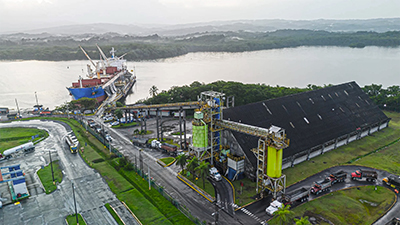
A significant milestone this year was the consolidation of the Bahía Las Minas terminal, located in the province of Colón, Panama. Starting in 2024, this terminal strengthened logistical capabilities, enabled the monetization of services, and became a central asset for Argos Cementos’ aggregate export strategy.
This demand trend in Central America positioned Panama as a key hub for the region, with the goal of strengthening market supply in the medium and long term. In Honduras, Argos Cementos focused its efforts on strengthening the industrial base and increasing the structural efficiency of this sector with the commissioning of the pozzolan dryer.
This represented a strategic advancement that expands cement capacity in that market, improves production stability, optimizes costs and reduces the clinker content in cement to lessen its environmental footprint.
Argos Cementos
Throughout 2025, Argos Cementos, through a series of investments, strengthened its operations in an increasingly competitive environment. This consolidation of its logistics assets aimed to open new opportunities beyond the local cycle and foster industrial advancements in the cement industry throughout Central America.
In its new annual report, Argos Cementos states that cement shipments reached 1.5 million tons of cement and 99,000 cu. meters of concrete in 2025. Consolidated revenues were $ 275 million, with adjusted EBITDA of $58 million and an EBITDA margin of 21.1%, reflecting an expansion of 151 basis points compared to 2024.
In the Dominican Republic, the company also consolidated a very strong performance, supported by sustained demand from the tourism, services and infrastructure sectors.
The commissioning of the pre-milling facility strengthened operational efficiency and production capacity, resulting in record shipment levels and profitability. As a result, compared to 2024, production grew by 11% and exceeded 700,000 tons for the first time in the company’s history.
Furthermore, progress was made in implementing its energy transition program, achieving a 50% renewable energy source for the energy used at the Najayo cement plant. Additionally, the company Interagg, in partnership with a major local client, was launched in 2025, becoming a key component of the new aggregates platform for re-entry into the United States market.
In Puerto Rico, 2025 was marked by stability and the continued evolution of the operating model. In a market with opportunities related to reconstruction and infrastructure investment, Argos reinforced its role as a reliable technical partner through its participation in key projects for the island, including the modernization of infrastructure such as the Luis Muñoz Marín International Airport.
In Haiti, despite the complex sociopolitical situation, the company managed to stabilize its current business model and achieve positive results that demonstrate its operational adaptability. During the year, shipment volume grew by approximately 85%, and customer service was strengthened by re-establishing a presence in the north of the country, a market that is once again opening doors to new opportunities.
Performance in Suriname and French Guiana during 2025 was characterized by a strengthened strategic position and preparation for new growth opportunities. In Suriname, progress was made in business development and expanding the local presence to support the potential of the oil and gas sector through the construction of new infrastructure.
Furthermore, the construction of the new cement silo in Antigua was completed, which, along with other projects, increased cement storage capacity and strengthened the reliability of supply in the subregion.
In the Dominican Republic, after a year, Cementos Cibao, a company with a long history in this industry, also inaugurated a new clinker production line at its Palo Amarillo plant, located in the city of Santiago de los Caballeros. This project was developed by the Chinese company Sinoma, a subsidiary of China National Building Material (CNBM).
In general, the new production line offers an advanced automation system, thermal efficiency, reduced energy consumption, and a low environmental impact thanks to new particle capture and filtration systems.
With the installation of the new equipment, clinker production capacity will be 3,500 tons per day, double the previous capacity. The equipment installed includes a new rotary kiln, a multi-stage preheating tower and a high-efficiency precalciner.
This, taken together, significantly improves fossil fuel consumption. The new high-thermal-recovery grate cooler incorporated into the new line allows for heat recovery for the kiln, reducing fuel consumption and increasing the efficiency of the production process.
The project also includes new mining infrastructure with the installation of a conveyor belt from the Los Melaos quarry and a new system for handling limestone and other raw materials.
The company also integrated a comprehensive automation system for real-time monitoring of the entire cement production process.
Currently, Cementos Cibao has a production of 2.1 million tpy, which was maintained during 2024 and most of 2025 while the new clinker line was under construction.
Mauro Nogarin is Cement Optimized’s Latin American correspondent.